


The short answer: it depends on what you mean by cheaper.
If you’re asking which costs less to install tomorrow morning, wood wins. If you’re asking which costs less over the next twenty years of actually owning and maintaining a fence on your property, metal (specifically quality steel board fencing) wins decisively.
Most ranchers make fencing decisions based on upfront sticker price. Can’t blame them. When you’re looking at quotes and the wood option is $18 per foot while metal is $32 per foot, the choice seems obvious.
Well, until you’re three years in, painting the fence for the second time, replacing broken boards, and realizing that cheap fence is costing you every single weekend.
The real question isn’t whether metal fences are cheaper than wood. It’s whether you’re calculating cost correctly: as a single transaction or as a long-term investment in your property. Because those two ways of thinking lead to very different conclusions about what’s actually economical.
Metal Fence vs. Wood Fence Installation Costs
Let’s start with the number everyone focuses on: what it costs to get a fence installed.
Wood Rail Fencing
Quality wood board fencing runs $20-28 per linear foot installed, depending on wood species, board count, and your region. Cedar and treated pine dominate the market. The installation is relatively straightforward—posts set in concrete, boards attached with nails or screws. Most contractors know wood fencing, so labor availability and competitive pricing work in your favor.
For a standard 3-rail configuration on 1,000 feet, you’re looking at $20,000-28,000 installed. Add another $3-5 per foot for 4-rail or premium wood species. The accessibility of wood materials and installer familiarity keeps these costs predictable and relatively competitive.
Metal Fencing Options
This is where terminology matters because “metal fencing” covers vastly different products and price points.
Pipe fence runs $25-40 per foot depending on pipe diameter and whether you’re using continuous rail or welded panels. It’s the strongest option but overkill for most horse applications beyond working pens and high-pressure areas.
Chain link comes in at $12-20 per foot installed, making it the most economical metal option. But it’s unsuitable as primary horse fencing due to climbing potential and injury risks. We see it used for dog runs and equipment areas, not horse containment.
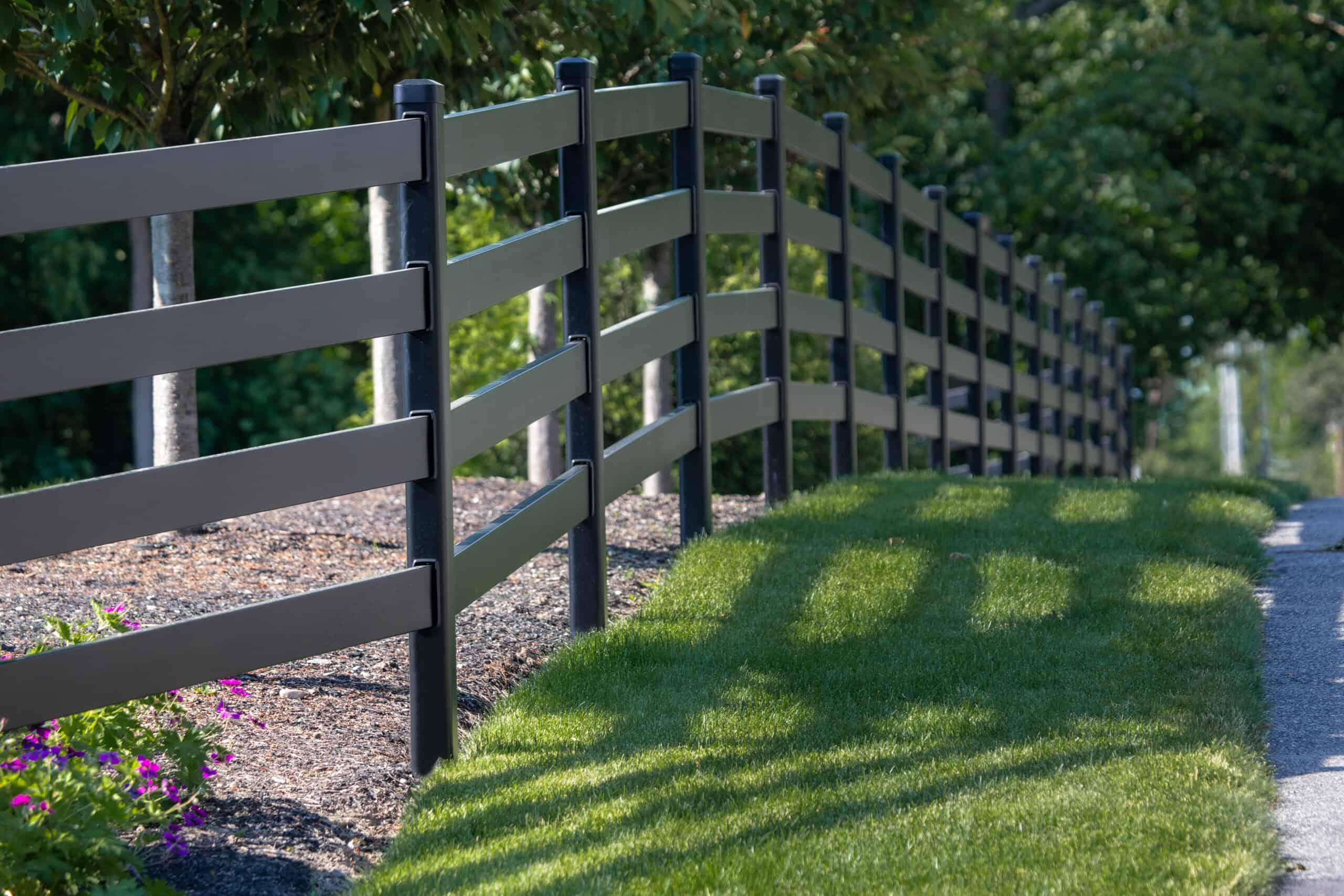
Our steel board fencing runs $22-24 per foot installed for 3-rail configurations. That’s $22,000-24,000 for 1,000 feet. Yes, it costs more initially than wood—roughly $6,000-$8,000 more on that 1,000-foot run. That number makes some ranchers stop reading right here.
But installation cost is just the opening bid in a decades-long investment.
The Hidden Costs Wood Owners Don’t Calculate
Here’s what happens after wood fence installation that most ranchers don’t factor into their “cheaper” decision.
1. Painting and Staining
Wood fencing needs protective coating every 3-4 years to maintain appearance and prevent accelerated rot. You’ve got two choices: do it yourself or hire it out.
DIY means buying paint or stain ($150-300 for 1,000 feet of material), plus pressure washer rental, brushes, and a week of your life every few years. Most ranchers start with good intentions, then let it slide as other priorities take over.
That’s when wood deteriorates faster.
Hire it out and you’re paying $3-5 per linear foot every 3-4 years. On 1,000 feet, that’s $3,000-5,000 per painting cycle. Over twenty years, figure five painting cycles: $15,000-25,000 just maintaining the finish.
2. Board Replacement
Wood boards crack, split, warp, and rot. Count on replacing 10-15% every 5-7 years even with good maintenance. That’s 100-150 boards on a 3-rail, 1,000-foot fence line. At $8-12 per board installed, you’re spending $800-1,800 per replacement cycle.
Over twenty years, that’s three cycles minimum: $2,400-5,400.
Horses accelerate this timeline by leaning, scratching, and occasionally running through weak sections. Properties with heavy horse pressure see board replacement approach 20% every five years.
3. Post Replacement
Ground-contact deterioration eventually claims even treated posts. Figure on replacing 5-10% of posts over twenty years at $75-125 per post. On 1,000 feet with standard 8-foot spacing, that’s 125 posts total, and replacing 6-12 posts means another $450-1,500.
4. Time Cost
The hidden killer in wood fence economics is your time. Painting 1,000 feet isn’t a weekend project—it’s 40-60 hours of work. Inspecting for damage, replacing boards, touching up problem areas—figure another 20-30 hours annually.
Over twenty years, that’s 500+ hours of fence maintenance.
Value your time at $25/hour and you’ve spent $12,500. Value it at $50/hour (which serious business owners should) and that’s $25,000 in opportunity cost. Time you could have spent training horses, building your operation, or simply enjoying your property instead of maintaining a fence.
Metal Fencing Maintenance Reality
Our steel board fencing system was engineered specifically to eliminate maintenance cycles. The dual-layer protection (hot-dip galvanization plus architectural powder coating) prevents rust for decades.
We’ve got installations pushing forty years without rust, without painting, without the constant attention wood demands.
Maintenance consists of quarterly walk-throughs checking connection tightness and gate operation. Annually, you might spend 2-3 hours tightening hardware. That’s it.
- No painting.
- No board replacement.
- No weekends lost to fence maintenance.
Over twenty years on that 1,000-foot fence line, figure 100 hours total maintenance versus 500+ hours for wood. The time savings alone justifies the initial cost difference for most operations.
Twenty-Year Total Cost Comparison
Let’s calculate real numbers on 1,000 feet of 3-rail fencing over twenty years.
Wood Board Fencing Total Cost:
- Initial installation: $24,000 (mid-range estimate)
- Painting (5 cycles @ $4,000): $20,000
- Board replacement (3 cycles @ $1,500): $4,500
- Post replacement: $1,000
- Time cost (500 hours @ $25/hour): $12,500
- Twenty-Year Total: $62,000
And here’s the kicker—you’re replacing the entire fence at year 20-25 because wood doesn’t last beyond that even with good maintenance. So add another $24,000+ for complete replacement.
Steel Board Fencing Total Cost:
- Initial installation: $32,500 (mid-range estimate)
- Maintenance materials: $500
- Time cost (100 hours @ $25/hour): $2,500
- Twenty-Year Total: $35,500
At year 20, your steel board fence is still performing like new with decades of life remaining. No replacement needed. That $8,500 “premium” you paid upfront saved you $26,500 over twenty years. And the fence keeps delivering value for another 10-30 years beyond.
The economics get more dramatic with larger properties. On 2,000 feet, the twenty-year difference approaches $55,000. On 5,000 feet, you’re looking at $135,000+ in total costs avoided.
Factors That Change the Math
Certain situations make metal fencing even more economical relative to wood.
- Climate Extremes: Harsh weather accelerates wood deterioration dramatically. Coastal salt air, extreme temperature cycling, and high humidity all shorten wood’s already limited lifespan. Metal fencing (particularly our coastal-appropriate steel board system) maintains performance regardless of climate.
- Horse Pressure: Properties with young horses, stallions, or high-density turnout see accelerated board damage. What might be 10% replacement becomes 25% every few years. Metal absorbs this abuse without damage, eliminating the horse-pressure maintenance multiplier.
- Labor Costs: DIY capability changes the equation. If you’re physically capable of painting and repairing wood fence, the labor cost drops (though time cost remains). If you’re hiring all maintenance, wood becomes even more expensive relative to metal.
- Property Scale: Small paddocks make wood’s maintenance manageable. Long horse fences across large properties make it overwhelming. The breaking point where metal becomes economically obvious varies by operation, but it’s typically around 1,000-1,500 feet of total fencing.
When Wood Makes More Sense
Sometimes, wood is the better option, though. Here’s when wood pencils out better than metal.
- Very Small Installations: Decorative paddocks under 200 feet where aesthetics trump economics might justify wood. The total maintenance burden stays small enough to remain manageable, and if you’re specifically after rustic appearance, a wood fence delivers that authentically.
- Temporary Needs: If you’re fencing property you plan to sell within 5 years, wood’s lower upfront cost makes sense since you won’t own it long enough to face major maintenance cycles. The next owner inherits those costs.
- Available Labor: Operations with staff specifically dedicated to property maintenance can absorb wood fence upkeep without disrupting core business. Large breeding farms with full-time maintenance crews don’t face the same time-cost burden as smaller owner-operated facilities.
- Budget Constraints: Sometimes you need fence now and don’t have the capital for metal. In that case, wood provides an acceptable interim solution. Consider it phase one, with plans to upgrade to metal as budget allows. Better to have an adequate wood fence than no fence at all.
Invest Once, Protect Forever
The cheapest fence is the one you only buy once. Wood isn’t that fence. Quality metal is.
We’ve engineered our steel board system for ranchers who understand that real economy comes from buying right the first time. These are materials that protect horses, maintain appearance, and deliver decades of service without constant attention.
Yes, it costs more initially. That’s the price of not replacing your fence in fifteen years. Not spending every spring painting. Not chasing horses that found the weak board you didn’t notice yet.
- Review our best types of metal fences to understand options beyond just steel board.
- Compare 3 vs 4 rail configurations to optimize both cost and functionality.
- Check our maintenance cost comparison for detailed breakdowns across different materials.
- Browse our installation gallery to see how steel board fencing looks on real properties.
- Read customer testimonials describing their experiences with long-term costs and performance.
Your horses deserve better than cheap fences. Your property deserves materials that improve rather than detract from value. And you deserve to spend weekends enjoying your operation instead of maintaining it.
Contact us for accurate pricing on your specific property. We’ll show you exactly what quality metal fencing costs upfront and what it saves over the lifespan of your ownership.
Let’s build something that lasts.
Frequently Asked Questions
How long does wood fencing last compared to metal?
Wood fencing lasts 15-20 years with excellent maintenance, 10-15 years with typical maintenance. Metal steel board fencing lasts 30-50+ years with minimal maintenance. Wood requires complete replacement within most property owners’ time horizon. Quality metal outlasts the original owner.
Can I save money doing DIY installation for either material?
Wood installation is more DIY-friendly for experienced builders. Metal steel board installation requires proper equipment and technique but is manageable for capable ranchers following our installation guides. Poor installation compromises any material, so factor professional installation costs unless you’re confident in your abilities and have necessary equipment.
Which fence material provides better property value return?
Quality metal fencing provides superior property value return because it maintains appearance and functionality long-term. Deteriorating wood fence actively detracts from property value. Appraisers and buyers recognize quality fencing as permanent improvement that won’t require immediate replacement, justifying higher asking prices.
